Friday, February 17, 2023

Research: Three Months in the Mediterranean, 1943 (2)

 Where Are the Allied Forces Destined to Invade Sicily, July 10?

News From Abroad as found in The Montreal Gazette

Armada to Sicily: Allied invasion ships set out, July 3 - 10, 1943. On
board the sloop HMS Alynbank, in convoy. © Imperial War Museum 17903
"Part of the huge Allied convoy on their way to Sicily" by Lt. E. E. Allen, RN

Introduction:

The 'Armada to Sicily', the largest in history up to that date in July, 1943, disembarked from different Allied ports at different times and took different routes to a large, secret staging area in order to not give the game away, to escape expected German resistance by way of, e.g., submarine attack, to confuse Axis leaders as to the 'when' and the 'where' the "soft under belly of Europe" was to be smashed with a sturdy, determined fist.

The first paragraph of the first news clipping from The Montreal Gazette below (Axis Scans Invasion Coasts) states "a big convoy battle was reported off Portugal" and that made me think of two things. First, part of the armada was made up of ships - convoys of ships - from England, if not filled with members of Montgomery's Eighth Army then at least tons of their supplies. Second, many of the Canadians in Combined Operations that I've come to know over the last ten years - and their WWII experiences via research in part (including my father, a Canadian sailor I met first in 1949... then onward) - travelled in convoys around the continent of Africa, beginning their voyages in May and/or June '43, rather than venture through the Strait of Gibraltar into the Mediterranean where serious dangers lurked in the air and under the sea.

Photographs below relate to some of the members of the RCNVR who volunteered for the British organization called Combined Operations (C. Ops.; about 1% (approx. 1,000) of those who joined the Canadian Navy joined C. Ops and became expert at handling, manning, driving various types of landing craft) and made their way to Sicily via the Cape of Good Hope and the Red Sea:

Canadians in Combined Ops aboard HMS Keren, 1943, in the 'Atlantic'
From the collection of Doug Harrison (see below)

Note the sailing date 'for Sicily', i.e., April 1943

The S. S. Silver Walnut, from the collection of Doug Harrison

Though no one has landed on the shores of Sicily yet, I include the following items from July 3 and 5 in order to provide some context related to the early days of "3 months in The Med" for Allied forces - from a Canadian newspaper's POV. Plus, I may find a particular 'star' war correspondent's stories that solve a mystery for me. 

Behold, The Montreal Gazette for only 5 cents(!):


Get to the Snowdon. It's air conditioned every once in a while!

You never know if audiences will take to her


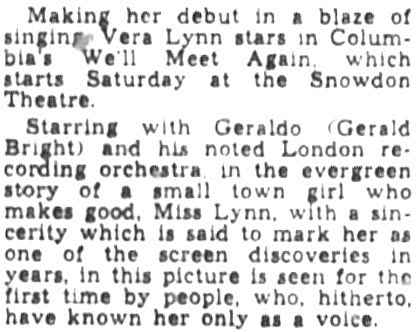
Did this happen very often?


As I mentioned in Part 1 of this (eventually lengthy) series of posts, Italy hitched its destiny to a 'ruthless war wagon', and it will soon pay. But first, Sicily (and Pantelleria) will pay.  


My father wrote that when he and mates went on leave in England in the 1940s they would "paint the town brown", and I take that to mean they would drink brown ale ('paint the town red' was for wine drinkers) until it was coming out their ears. My father also mentions that he would pick up multiple cartons of cigarets (was there a cost or were they free?) before heading out the gate - or under a fence maybe (see below next article) - of the navy base or camp. Did he use them for trades, for barter? It would not surprise me. 


"Len Birkenes returning on board at Irvine (Camp Auchengate, Navy)
through a makeshift gangway." From a book of Canadian Navy veterans'

Most of the countries involved in WWII saw the "battle to out-produce the enemy" was of critical importance. As planes, tanks, guns, ships, etc. were destroyed, new ones were needed to replace them, and more fuel was required to power the factories. As well, more and more women were being trained to fill jobs once held by men. As WWII progressed Germany lost more and more battles on every side, including the war re production:


Rosie the Riveter is an allegorical cultural icon in the United States who
represents the women who worked in factories and shipyards during WWII,
many of whom produced munitions and war supplies. These women sometimes
took entirely new jobs replacing the male workers who joined the military.
Details in caption from Wikipedia. Photo - found at nationalww2museum


Readers can link to a short video here [01min:13sec] re bombing raid over Sicily at Palermo. Notes with the video - Various air to air shots of of Flying Fortresses heading out over Sicily. Aerial bombing shots over Marsala and Palermo. Air to air shots of a B.17 bomber with damaged tail. Various shots of the B.17 bombers after making crash landing.

In some cases German production of various types of weaponry was not an issue, but ammunition dumps were "very depleted."


An Italian mutiny leads to executions:


Canada production levels are growing. Perhaps related to weaponry,
but definitely related to the paint that protects guns from the weather.
As found in a newspaper ad, The Montreal Star, July 3, 1943.

More details from another Canadian newspaper - also from July 3, 1943 - can be found at Context: Days Before Operation HUSKY (Sicily)

And now on to July 5, 1943:


A Closer Look at a certain paragraph above:


About "Italy can be knocked out of the war this year": The Italian "collapse" (unconditional surrender) did not occur when the invasion of Sicily began on July 10. However, very shortly after the invasion of Italy at the toe of the boot, beginning Sept. 3, 1943, Italian forces, the weakest wing of the Axis power surrendered, two months after this article was written.

About Germany, the strongest wing: There were in fact "too many Germans in the peninsula" and it is a very long peninsula. 

[My father was interviewed by a reporter from The Brantford Expositor when he returned to Canada in December, 1943, after 'three months in the Mediterranean'. The reporter writes, 'LS. Harrison expects to return overseas on completion of his leave at home. He said he would not commit himself by making any prediction as to the length of the war, as the enemy was “a pretty tough customer, and will take a lot of beating.”

They sure did. Allied forces did not victoriously enter Rome until June 5, 1944, eleven months to the day after the above article was written. 

I will regularly share a few items like the one below that give a few details about WWII activity on various war fronts - world wide - because I tend to concentrate, as many readers have already discovered, on activities related to the RCNVR, particularly those sailors who volunteered for Combined Operations like my father did in late 1941.

As far as I know at this point, only 950 - 1,000 Canadians 'signed up' so to speak for that British organization on the strength of a few key details on a 'help wanted' poster a few navy boys spotted while training at HMCS Stadacona in Halifax, Nova Scotia. I.e., "dangerous duties overseas"; "small craft"; "nine days leave" thrown in. Well, who wouldn't want to see the world after getting a free pass to go home for Christmas in late 1941?

For more details about that 'help wanted' poster and how the Canadian boys embraced it, email me at gordh7700@gmail.com

What's happening out there?


Just a few details follow about how much I didn't know about my father's WWII service until well after he had passed away. These lines were inspired by the headline below, "MENACE OF U-BOAT...":

It was a very hot summer's day in Ottawa, 2012, when I entered the city via the main drag, Rideau Street, travelling from the east. (A week earlier I had been in Halifax with the goal to bury my father at sea. And I succeeded.) My motorcycle was boiling to the touch, so was I, and when I stopped at yet another red light ("I hit them all!") I flipped up my helmet's visor for some little relief, looked around for street signs to confirm I was on a good route  - "I turn left in two more blocks" - in spite of nearing human spontaneous combustion levels.

Through a cloud of sweat I spotted a used book store on my right. I made a quick mental note - visit it later (because I love them). And a book title on an outdoor rack was large enough to read. Be quick, traffic's moving. U-BOAT WAR, I read. I will go back, I thought. Dad wrote about an encounter with one. And I did go back... 


I did go back to the used-book store and bought the book, all 20 pounds of it. And one more. I read the second one first, it was much smaller and lighter. That being said, U-BOAT WAR was and is one of my favourite books related to WWII.

The book was later turned into a movie. Link to Das Boot

It filled me with dread and after reading the carefully compiled stats at the back of the book about 'tonnage of freight lost', 'number of ships sunk', etc., it  made me say out loud, "Why would anyone want to join the Merchant Marine (MM)?" And at the time of visiting Ottawa after burying my father at sea (tossing a wooden boat filled with his ashes into the Atlantic is more like it), as per his request, I believed he had been a member of the MM. But he wasn't. He was in the RCNVR and Combined Ops.

More about the long learning curve as this series grows. More about the book U-Boat War can be found at WW2: Ten Poignant Stories (4) and WW2: Recommended Reading (6).

News clippings from The Gazette continue (And no, my father wasn't in the Navy League as far as I know):


Here's a story that could also be turned into a movie! Das Plane!


Das Mayor!


Everybody loves a good comedy?


"Many planes returned with holes in the winks?" The following story could be one easily passed along to surviving family members related to (at least) one of the Canadian pilots mentioned...

What are the odds?


What are the odds of passing along the above story? Poor. I checked an online phone book re several of the above names and came up empty-handed.

An Allied invasion is in fact coming very soon:


More to follow from The Montreal Gazette, July - September, 1943

Please click here read Research: Three Months in the Mediterranean, 1943 (1)

Unattributed Photos GH

Saturday, February 11, 2023

Research: Three Months in the Mediterranean, 1943 (1)

Allied Progress in the Mediterranean as Printed 80 Yrs Ago (from 2023)

And the Hunt for a Montreal War Correspondent is Renewed!

Italy is hitched to a ruthless war wagon and Sicily will pay

Introduction:

In 2023 we will be reminded in more than a few ways that a significant anniversary is at hand. Sicily was invaded by Allied forces beginning in July 10, 1943, and mainland Italy was invaded about two months later beginning on September 3, exactly 80 years earlier than those same dates this year. Will there be ceremonies, services, memories and memoirs shared, reminders of the brutality of war and its inevitable and long-lasting costs?

I'm sure there will be. Hymns will be sung, stories told, Butchers' Bills in today's dollars will be tabulated, the loss of young men and women who died under their country's flag will be mourned.

I will visit Sicily in August, near the middle of the two most significant dates, i.e., the D-Days for Operation Husky and Operation Baytown, come home with a zillion photos, the odd new story or two (you'll hear them here first!), and perhaps a deeper understanding about my father's experiences in 'the Med' as a member of RCNVR and Combined Operations when he was a 23-year old.

Gordon 'Doug' Harrison turned 23 on Sept. 6, 1943, three days after the initial invasion of Italy on the toe of the boot, at Reggio, and celebrated aboard a landing craft mechanised (LCM) as it crossed the Strait of Messina loaded down with Canadian soldiers and the material of war. "12 hours on, 12 hours off" was his schedule for most of that month.

With the Invasion Fleet: Troops Manning their Assault Landing Craft before
the Landings in Sicily, Dawn, July 10th 1943. "The deck of a ship at night. A line
of fully kitted out troops prepare to board a landing craft, each soldier with his
hand on the shoulder of the man in front to help guide each other in the dark."
Imperial War Museum, ART LD 3452 by Ardizzone, Edward Jeffrey Irving

Over the next few weeks I will be searching The Montreal Gazette - as found on microfilm at University of Western Ontario - for news stories from the Med as published between July 1 and September 30, 1943, about the length of time my father and approx. 400 - 500 other Canadian sailors were serving there. (How many exactly were in RCNVR and Combined Operations, like my father and mates? I do not know).

I will surely find 100s and 100s of individual clippings by various war correspondents, many of them from Canada, along with old photographs, editorials, cartoons, movie posters and ads (etc.) to provide details and context re WWII and hopefully inform the reader of various roles filled by Canadians on various war fronts, whether on land or sea or in the air.

That being said, I will particularly be watching for an article or two by one certain writer from the Montreal newspaper because a young sailor in the 80th Flotilla of Canadian Landing Crafts said in memoirs that he delivered a reporter to Italy in his landing craft. That particular sentence - please see below - launched me on a lengthy research task many months ago re The Montreal Star, including a particular war correspondent, Sholto Watt. "Could he be the guy?" I wondered at the time. 

My conclusion at the end of a lengthy search was, "It must have been someone else. Maybe the sailor got the name of the paper wrong."


Details that led me on quite the adventure, as found in
Combined Operations by Londoner Clayton Marks.

Maybe the sailor meant from "The Montreal Gazette." Or maybe he meant from "The Montreal Standard" or "The Toronto Star," even "The Windsor Star." Maybe I'll be searching microfiche files for years to come!

Follow along if you will to "Three Months in the Mediterranean, 1943." Questions and comments can be addressed to me at gordh7700@gmail.com


Churchill is careful not to spill the beans, or, the invasion date:


The ferry between Messina and, e.g., Reggio (toe of Italy's boot) became a target for some time, perhaps to strand German troops on the island of Sicily. I hope it is back in action because I will want to follow my father's faint footsteps this coming summer.


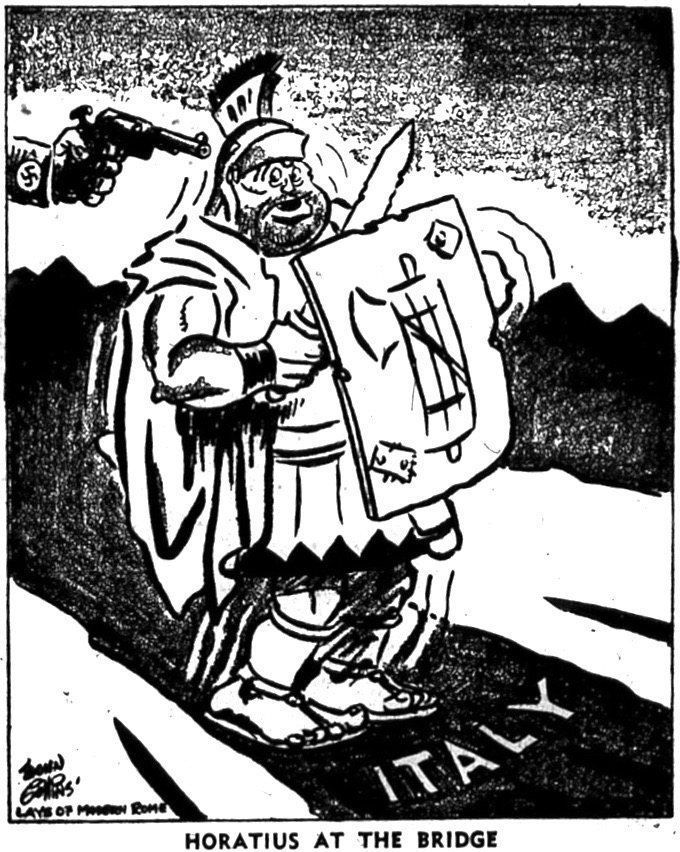
The editorial cartoon from July 1, 1943:


Many hundreds of members of RCNVR served in the Mediterranean but a relatively small number or percentage were in charge of landing crafts. Stories about the duties they fulfilled are rare enough, and stories related to a father and son at the same time - in any capacity - are rarer still, especially those written by a member of the family:


Canadian war correspondents play an important part in my search for more information about Canadians in Combined Operations - "Hey, is my Dad mentioned in any stories?" - as well as Canadian servicemen and women no matter what uniform they are wearing. In the past many of those writers mentioned below have been featured in some way on this site, and a few mentioned, in fine detail, the exploits and responsibilities of the sailors who manned landing crafts in the early hours of D-Day Sicily (July 10) and D-Day Italy (Sept. 3, 1943) and also for several weeks after troops were initially landed to secure beachheads. 

I have wondered for a few years if I can find the writer mentioned early who travelled aboard a Canadian landing craft to Reggio. Careful readers, who have spotted some of the stories I have shared by Ross Munro, may already be thinking I need look no farther. Yes, I have wondered about Mr. Munro because he seemed destined to scoop every other Canadian war correspondent about the first landings by Canadian troops wherever they landed, from Dieppe to Reggio. But, to my mind, I don't think I've read a story where he mentions landing in Sicily or Italy with a Canadian landing craft crew. Surely I would have remembered or featured it already!

So, I'll keep looking. If I have no luck with The Montreal Gazette then I will move on to The Montreal Standard... and so on until I feel I've turned over every stone. PS - if you do find a Munro article re his ride to Reggio, please let me know!


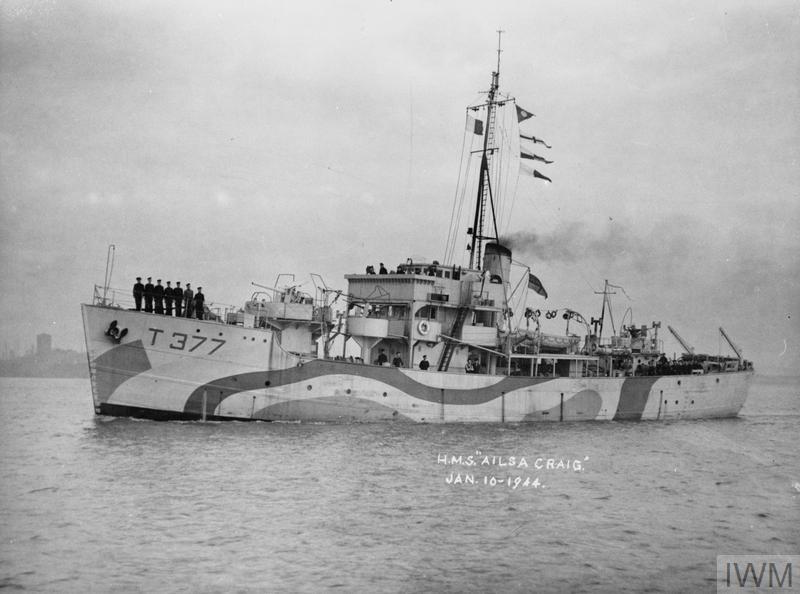
Did you know that Midland, Ontario, played an important role - associated with the Royal Navy - during WWII?


More information about the 'Isles-class Trawlers' (aka island class) can be found at Wikipedia. Under the heading 'Builders' one will find Midland Shipyards, of Midland, Ontario, Canada. 

 H.M.T. (aka H.M.S) Ailsa Craig. Underway, coastal waters. Pennant No T377. 
Photo Credit - IWM FL 292 at Imperial War Museum

More about Naval Trawlers can also be found at another page on Wikipedia, and I recommend it here because some very good artwork is included in the accompanying 'Gallery'. By clicking the art pieces one will discover their connection to the Imperial War Museum. They are very informative and high quality pieces. I chose to share the following charcoal drawing because my Grandfather Harrison was a stoker with the Royal Navy. And because he was good with a shovel, he later became a grave digger in my hometown, Norwich, Ontario:

The Stokehold, HM Trawler Mackenzie. "In a cramped enclosed space
of metal plating and machinery, a stoker is bent over shovelling coal from
a bunker into a boiler." Imperial War Museum, IWM ART 903

Out of the stokehold and back to stories (etc.) from Sicily:


Do the words below - "Prelude To Invasion" - give the game away? Were the Allies pointing to Sicily, or some part of it, as their landing place in an upcoming invasion? 

Though the island would certainly be among the possible or likely spots in the Mediterranean the Allies would wish to exploit, plans were already afoot to tease German and Italian leaders into believing (though an invasion seemed imminent) that it would not be on Sicily's shores.

"Attack Sicily en masse? Oh no, not us!" said the Allies. More details after the U.S.'s smashing prelude.


Allied forces advance with the greatest armada in history (up to that time)  
"A view from the bridge of HMS Alynbank of the huge Allied convoy on their
way to Sicily." Photo Credit - Lt. E. E. Allen, RN Photogr. © IWM A 17904 

The news article continues with a brief description of a 'combined operation' (i.e., "a delicate coordination of land, sea, and air forces" that includes "a fierce concentration of air bombing and sea bombardment" - parts of which were absent during the Dieppe raid - and "the technique of bombing invasion points into complete submission", etc.)


The Allied ploy to tease Axis defenders to look elsewhere ("Attack Sicily? You must be kidding.") is ably described in the book below (Very good reading by the way):

A movie has been made based on this true story by Ben McIntyre. Details here.
Questions or comments can be addressed to me at gordh7700@gmail.com

After reading many articles about the amount of shipping destroyed by German U-boats, this one confirms that "times have changed":


I would suspect that "ALLIED BOMBS" had a good deal to do with the capitulation Italy during the summer of 1943:


An author touches on what a future invasion of Europe might entail. He may be correct about his assumptions re the Dieppe raid...


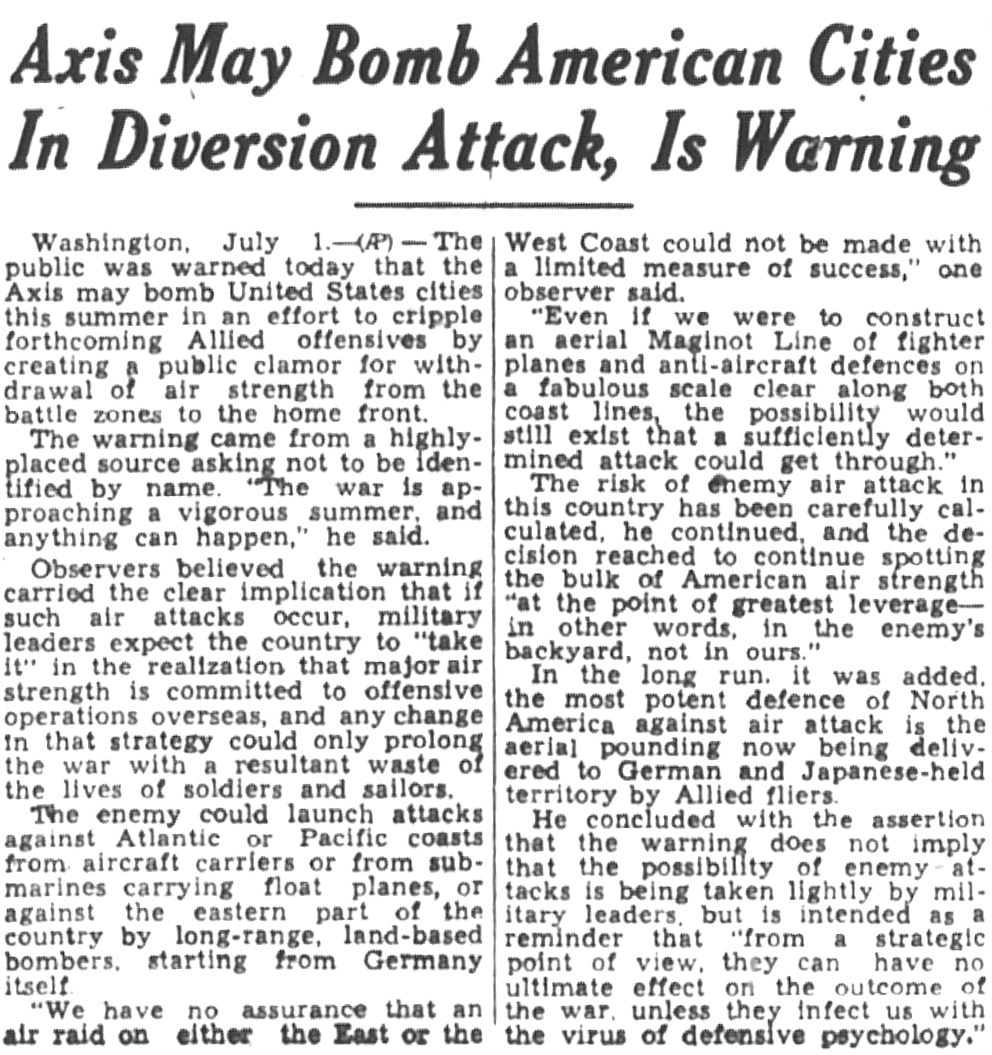
Food for thought? If the USA is worried about the bombing of American cities, one thing they could do is turn all the lights out! German submarines (for a time) had many happy days sinking supply ships along America's eastern seaboard at night because the cities were so well lit.


More news clippings from The Montreal Gazette will soon follow. My walking trips to the University of Western Ontario have been good exercise in the month of February (so far) and I already have 1,000+ clippings to share, some touching on Canadians in Combined Operations, others by a particular war correspondent that has caught my eye. The one who accompanied Canadians in the 80th Flotilla of Landing crafts during Operation Baytown? It's definitely a possibility. (More details to follow re L. Shapiro!)

Please click here to view an item by Doug Harrison related to the invasion of Sicily -
Passages: Canadians in Combined Ops - Sicily

Unattributed Photos GH 

Saturday, February 4, 2023

Correspondence: "My Grandad Served on the Reina Del Pacifico" (Part 2)

"I Was Involved in Four Invasions; Norway,
North Africa, Sicily and Italy."

A very healthy-sized tot of rum (excellent idea, in my opinion. Be right back)!
Photo with permission of Mark Pountney, with his Grandad. Cheers!

Introduction:

A number of years ago (I'm embarrassed to say how many) I was informed via email from Mark Pountney of England that his Grandad Herbert Jones ("a bosun and quartermaster" during WWII) had been on the liner Reina Del Pacifico off the shores of North Africa, at the very same time my father Doug Harrison was in the very same area. 

Even better. Reina Del ('Queen of the Pacific', converted from ocean-going liner to troopship) was carrying U.S. soldiers for the first time, and my father (RCNVR/Combined Operations) was charged with carrying those troops to shore, with many of their supplies, on board Landing Craft, Assault (LCAs) and Landing Craft, Mechanised (LCMs) morning, noon and night for several days on end without a break.

American troops manning their landing craft assault (LCA) from a doorway
in the side of the liner Reina Del Pacifico. (D. Harrison, second from left).
 Photo Credit - RN Lt. F. A. Hudson. Imperial War Museum (A12647, IWM)

Would the two men have met?*

As I said in an earlier post re our correspondence, the odds "are not impossibly thin" because my father was able to go aboard the Reina Del for rest, recuperation and "a big tot of rum" after four days of work aboard landing crafts during Operation TORCH, November 1942. The odds get thicker when I consider that Mr. Jones and Mr. Harrison served in Sicily and Italy at the same time as well - for lengthy durations - from July - September (Operations HUSKY, BAYTOWN, and AVALANCHE), the year after the invasion of North Africa by Allied forces. 

Mark Pountney reinvigorated our correspondence on Remembrance Day, 2022: 

From: Mark
Sent: 11 November 2022
To: Gord
Subject: RE: Reina Del Pacifico

Hi Gord,

How are you? It’s been a long time. I was just checking your site again, I’m so glad you’ve kept it up to date with more articles. 

There are some more images of the Reina Del  although I’m sure you have seen them.

HMS Reina Del Pacifico ("Underway"), w landing crafts hanging from davits.
Photo by J. Hall, Gourock, Scotland. Imperial War Museum (IWM) FL18191

I’ve been listening to the audio clips, lots of references to my local area, Liverpool, Birkenhead, Wallasey.

I’ll see if I can find any more info relating to my Grandad’s service.

Best wishes

Had I seen the photo Mark was referring to? I checked the link to IWM, found I had not seen the photo (!), saw an opportunity to also use a link to its photographer... and more. Good score, in my opinion!

According to my records, I wrote back in under six years:

Hi Mark, I am glad you got back in touch. Your email, linked to our first notes from several years ago, is an example of 'great timing!'

For Remembrance Day, I just happened to be putting two short entries together re Operation Torch, invasion of N. Africa, in which a few ships are mentioned - including the Reina Del, Derwentdale and a sister ship. Your email included good photos of Reina Del, so I was able to quickly add one to the second entry. I then remembered that the photographer's name acts as a live link to his collection of photos at IWM, so I clicked on his name - J. Hall - and it quickly led me to his photo of RFA Derwentdale, my father's ride to N. Africa... so I added it as well.


RFA Derwentdale, "At Anchor", by J. Hall, Gourock. IWM, FL11110

I wish you 'happy hunting' as you listen to audio clips. If you hear something re sailors visiting The Crown Pub in Wallasey, let me know. If The Crown still stands, I'd be tempted to get in touch with the owners! Even pop over for a pint.

I've had some good luck re audio files in the past. I'll keep digging too. My best luck of the past year or two (though I found several relevant WWII stories on decades-old microfilm) was the time a collector of militaria (from many miles away) googled the name and service number on a dusty duffle bag he'd purchased w a pile of 'other stuff' 30+ years ago... and the name/number led to my site. It was my father's duffle bag from 1944-45, his second during WWII. Long story short, I now have it back. So, I wish you that kind of luck as you continue your searches!!

Keep well.

My father's name and number are still visible on the duffel bag.
Returned to me before Fathers' Day 2021

A painted picture of (possibly) Betty Hutton, 1940s-style

And related to the above emails, when following the link to J. Hall of Gourock I found excellent photos of about a dozen other ships used during WWII as well as the aforementioned rides to N. Africa.

As well, the Imperial War Museum provides helpful links under many photographs to 'related subjects'. One subject caught my eye in particular re artwork produced during WWII under the heading 'What Life Was Like In Britain During The Second World War':

'Incendiaries in a Suburb, 1941' by Henry Carr, Great Britain
Photo Credit - Imperial War Museum, IWM Art LD 1518

Notes shared with Carr's painting:

This painting depicts an incendiary air raids, with explosions in the sky and fires raging in the distance. Civilians are putting out two incendiaries in their front garden. This is a jarring image of the war's effect on suburban Britain, with street lighting replaced by fires and normal life threatened and disturbed.

But for the next five years the British had to endure the bombing of their towns and cities in the Blitz, as well as attacks from flying bombs and rockets. In all 60,595 civilians were killed and 86,182 seriously injured. Rationing of food began in January 1940 and clothes in June 1941. By 1943, virtually every household item was either in short supply and had to be queued for, or was unobtainable.

The British were the most totally mobilised of all the major belligerents and there was a great and genuine community of spirit in wartime Britain which often transcended class and other barriers. But there was also an almost universal feeling, exemplified by the popularity of the 1942 Beveridge Report, that after victory the country could not go back to pre-war social conditions.

VE Day found Britain exhausted, drab and in poor shape, but justly proud of its unique role in gaining the Allied victory.

As some readers are well aware, resources housed at the Imperial War Museum are quite possible bottomless. Photographs alone reach into the millions upon millions. Then there are the resources related to other topics that catch my interest at times, e.g., the pubs my father visited with mates during his time in Great Britain and Scotland. I have been to a few but not all, and Mark subsequently provided information and links to one I mentioned above earlier, i.e., "The Crown Pub in Wallasey".

More correspondence to follow in the somewhat near future, less than six years time.

Please link to Correspondence: "My Grandad Served on the Reina Del Pacifico" (1)

*Would the two men have met: Final thought. In my experience, people who enjoy a tot of rum, a pint or two in a cozy pub, possibly a single malt - "whisky is but beer distilled" - now and again, tend to find others who feel the same. Well, that's how it works in my neighbourhood at any rate ; )

Questions or comments re the blog/website can be addressed to gordh7700@gmail.com

Unattributed Photos GH